

What Else Do You Have Going For You?
“Confidence is knowing who you are and not changing it a bit, because someone else’s version of reality is not your reality.”
Shannon L. Alder.
How Assertive are You?
Assertiveness is simply about being open and honest with yourself and other people. There are no magic tricks or secrets to it. It’s about listening to other’s viewpoints and demonstrating that you can understand them. It is about being able to face and deal with awkward or difficult situations, working to find a solution that suits everyone. Assertiveness is really about having respect for yourself and for other people.
It’s such an important skill for everybody that I will probably write a whole newsletter on it in the future. In the meantime, take a few minutes to assess your current level of assertiveness, to help you see what you already have going for you.
Circle the A, B, C or D response to identify how you tend to behave in these example situations. Complete the quiz quickly. Your first answers are usually the best and most accurate.
1) You’re making holiday plans and would prefer to go away just with your partner. A group of your friends have been planning for the last year to get away together for the same dates. Do you:
a. Feel that its unfair to have to make a choice and simply hope something will happen to sort out this mess?
b. Go with your friends – anything for a quiet life?
c. Say how you feel about the plans and what you would like to do?
d. Refuse to involve yourself with the friends’ planning?
2) You’ve taken the first sip of your coffee and it’s clearly not what you ordered. Do you:
a. Take it back to the counter, tell them you didn’t like it and order another drink?
b. Just get on with it and drink it?
c. Tell the staff it’s the wrong drink and ask for a replacement?
d. Tell the staff how rubbish they are at their job and that you’ll never buy coffee there again?
3) A friend has included you in a busy WhatsApp group despite you asking them not to. Do you:
a. Make irrelevant comments to show you are not really interested?
b. Simply ignore all the messages and say nothing?
c. Explain that you feel overwhelmed by the volume of message and ask to be removed from the group?
d. Send an angry message to the whole group complaining about your friend?
4) Your manager at work makes a sexist or misogynistic remark. Do you:
a. Keep the pretext that its banter and respond in that way?
b. Pretend you didn’t hear it and change the subject?
c. Express your concern about the remark if you feel safe to do that?
d. Tell them they are making illegal comments and you’ll get them sacked by telling HR?
5) You’re waiting in a queue to pay when someone jumps in in front of you. Do you:
a. Loudly clear your throat, shuffle your shopping and make irritated noises?
b. Just ignore what happened?
c. Calmly explain to the person that they have taken your place in the queue and ask them to go behind you?
d. Energetically tell them how rude and uncaring they are to jump in front of people who are following the rules and already queueing properly?
6) A colleague criticises something about your appearance at work. Do you:
a. Cover your embarrassment by saying something like “Oh yes, I haven’t been able to get to the hairdresser in ages”?
b. Feel uncomfortable and not really able to respond?
c. Check that you heard correctly what they said then work out how you will respond?
d. Respond by blurting out something similar (or worse) about them?
7) You’ve been asked to cover the weekend again at work when you already had plans with the family. Do you:
a. Remind your manager how important family life is and that everyone should protect time for it?
b. Initially refuse but then cave in and agree to do the work?
c. Clearly say that you can’t do this because you have other plans?
d. Complain how unfair it is that it’s always you and refuse to work any more weekends?
8) Your friend doesn’t seem to be paying attention when you’re telling them about a day out you had over the weekend. Do you:
a. Start talking rubbish sentences until they notice?
b. Just stop speaking?
c. Explain that you feel upset and you really wanted to share your experience with them?
d. Raise your voice and start talking very slowly?
Make a note of how many times you answered A, B, C or D and then look at the results below:
Are your answers mostly B? This means that your default behaviour tends towards passive. You prefer not to confront issues or make yourself more visible. You tend not to voice your opinions and often allow others to make decisions.
Are your answers mostly C? This means that you’ve indicated you would mainly tend to show assertive behaviour. It’s quite easy in a quiz to pick out what seems to be the most reasonable answer, so do be mindful of what happens for you in reality. In day-to-day exchanges, particularly those which are emotionally challenging, we can all easily default to more aggressive or more passive responses.
Are your answers mostly A or D? This means that you tend to behave more aggressively in these situations. If you chose mostly D you were choosing responses which are directly aggressive. Responses which are mostly A show that your behaviour can be indirectly aggressive and sometimes manipulative. This is sometimes also described as passive-aggressive – behaving in an apparently passive way which has hidden within it a hurtful or mean intent. Many of us can confuse assertive and aggressive behaviour and this is confounded by how assertiveness is often portrayed negatively in the media. It’s not unusual to have a sprinkling of As and Ds amongst your answers.
What do you want to change about how you might behave in these type of situations? Do you recognise any patterns in your behaviour? Take some time now to think about what you could do differently, stop doing or start doing.
How Much Confidence Do You Have?
Over the past few newsletters you may have discovered that you’ve got a lot going for you, but perhaps you aren’t fully using your skills and talents to help you because you lack the self-confidence to just get on with it. Or maybe there is something you know you need to work on, such as improving your transferable skills, but you’re not confident enough to take the first steps to do something about this.
Perhaps for you, confidence comes when you are in work where you have a good knowledge and relevant experience, or maybe you’re most confident with people you know (or alternatively with those who don’t know you). Some people are most confident in their life outside work with friends or family. We are all different and even if we are confident most of the time, there will be some situations which make us feel unbalanced, vulnerable or unworthy.
Confidence means:
- you believe in your abilities enough to give things a go
- you keep working towards what you want to achieve even when there are bumps in the road
- whatever happens your belief in yourself survives
- you can venture into the unknown recognizing that you’ll be able to deal with any eventualities
Lack of confidence means:
- you can struggle to make a start on things
- sometimes what you want to do just feels too far out of your reach
- you will put things off until you feel better, more skilled, ready…
- you worry you might fail or not really be up to it and that gets in the way of even starting
- you can feel a lack of control over your life or work or just certain situations
- even if things go well, you worry that some flaw or fault will be found and you’ll be exposed as an imposter
- its too easy to give up at the first hiccup or roadblock
- happiness or success seems to be only for other people
Over-confidence means:
- you are unrealistically optimistic in what is possible or achievable for you
- you can over-promise and under-deliver
- you don’t recognise when things are going wrong or going badly
- you can trip yourself up and find your confidence drained away
Does your self-confidence need a boost? Who are the people who undermine your self-confidence? What are the situations where you feel lacking in self-confidence? Do you feel less than adequate in your interactions with those in authority or who are senior to you? If so, then working on your assertiveness can help. Perhaps your confidence flees when you have to stand up and speak in front of people? This is very common (and completely understandable) and some people are OK speaking in front of strangers but not OK with people they know. You can help yourself with a presentation skills course, starting small simply by making a short announcement at a small meeting, maybe even just asking if everyone has an agenda or get tips and advice from a coach or mentor. You could also benefit from joining an organisation such as Toastmasters or your local amateur dramatics society or choir.
Confidence Ups and Downs
Use a table like this to identify when your confidence is high and when it is low. Consider and record a wide range of situations and contexts.
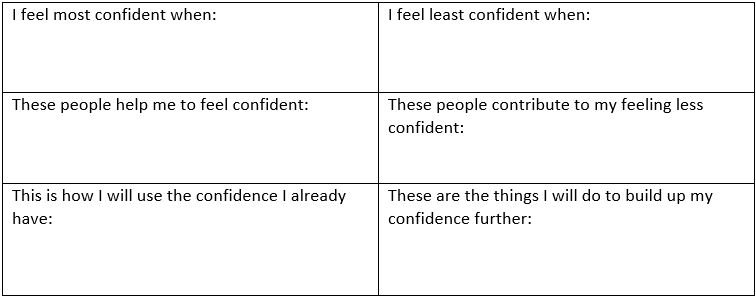
Work with the contexts and situations, and those others who help your confidence, as the starting points to develop your confidence further. For example if a certain person helps you feel confident can you be with them in a situation where you currently feel less confident.
If you have times when your confidence feels squeezed, how can you help yourself by remembering and revisiting your confident spaces and getting support from your confidence crew?